
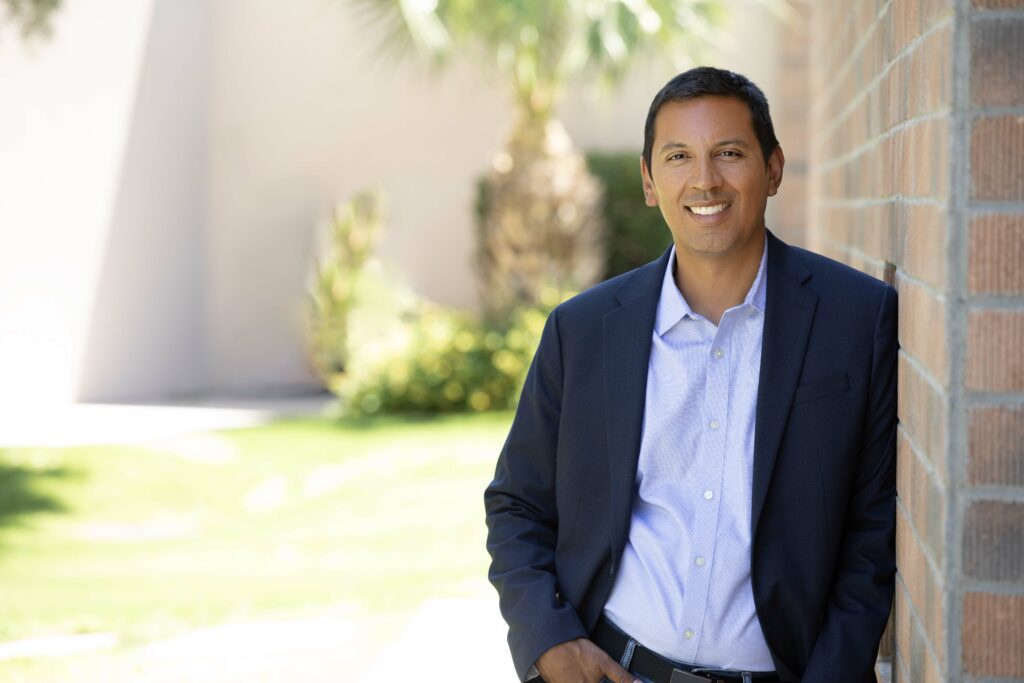
Eric J. Rodriguez
Eric J. Rodriguez is not your typical AI speaker. He built the automation before the world called it AI, then spent a decade watching what it did to people, and came away an optimist. The future, he argues, is not less human. It is more. He calls it the Human Era.
PRIMARY TOPICS
- Artificial Intelligence
- Future of Work
- AI and Workforce Development
- Technology and Change
- Human-Centered AI
- Leadership
- Innovation
- Organizational Development
- Hispanic Heritage
- First Generation
- Bilingual, English and Spanish
GETTING TO KNOW
ERIC J. RODRIGUEZ
Eric J. Rodriguez is an AI keynote speaker who spent seventeen years on both sides of the technology.
Born in Houston and raised in Guayaquil, Ecuador, where a seventh-grade computer lab opened a door he has spent his career opening for others, he began as a control systems engineer at a Shell refinery and then at Intel, building the automation that changed how work gets done. He later moved to the business side at Intel, in roles including Chief of Staff for a global business of 200 people across four industries.
Some of the people whose work he automated were displaced. Most found something the machines could not do and became more valuable for it. That is why he argues the future is not less human; it is more, and why he calls what comes next the Human Era.
He holds a BS in Electrical Engineering from the University of Houston and an MBA from Loyola University New Orleans. He speaks in English, Spanish, or both.
Keynotes
Eric Rodriguez’s Keynotes can be presented in English & Spanish
Building the Human Era
Equip an anxious room to see itself as the reason the next era works.
Every technology shift in history has been announced as an ending. This one is being announced to your people directly, and most of them have not been told the part that matters. The era replacing the industrial one needs them more, not less.
This keynote moves a room from anxious to unmistakably useful. It draws on eight years building factory automation at a Shell refinery and at Intel, then nine years on Intel’s business side watching what happened after the technology worked, and on the one lesson that experience teaches. Technology rarely fails at the silicon. It fails at the seam where it meets human beings.
Your audience walks out saying the same sentence to each other in the hallway. “I’d never seen it that way. This change can be led by me, not at me.”
Audience takeaways
What each person carries out of the room.
- A plain-language way to explain to any team what AI changed about their work and what it did not
- The difference between the tasks AI raised the floor on and the judgment it cannot reach
- Why adoption stalls at the human layer rather than the technical one
- One sentence they can say to their team on Monday that turns AI from a threat into an assignment
ORGANIZATIONAL IMPACT:
- Describe the shift now underway from technology advantage to human advantage, and what it changes about how they hire, develop and retain people.
- Explain why the organizations pulling ahead on AI are not the ones with the best technology stack, and name what those organizations are investing in instead.
- Identify one role or team where building the missing middle would compound fastest in their own organization, and describe the first move.
SET THE CEILING
Force the decision your leadership team has been making by accident.
Your competitors have access to the same models, the same platforms and increasingly the same capabilities you do. Whatever advantage came from simply having the tool is getting smaller every quarter.
The floor moved for the whole industry at once. Operational excellence alone stops protecting your margin, and what is left to compete on is not something any vendor sells.
Eric spent nine years on Intel’s business side watching two groups handle the same technology completely differently. The difference was not the technology alone. It was whether anyone had told them what they were for.
That decision is not a technology decision, and most leadership teams have not made it yet.
Audience takeaways
What each leader carries out of the room.
- The questions to answer before the next rollout instead of after it
- Why adoption stalls on accountability rather than capability
- How to tell a team what they are for in a way they actually believe
- A way to separate what the tools made cheap from what only their people can still do
Outcomes for your organization
What is different in the weeks after.
- In a keynote: every leader in the room writes their own answer to “what are our people for” before they leave. In the working session: the team works toward one answer they can actually act on.
- The next technology decision gets a named owner and a stated purpose before the contract gets signed
- Adoption stops being treated as a training problem and starts being treated as an accountability one
- A defensible reason to say no to the next tool that does not serve the answer, which is usually worth more than the keynote
Best for: executive retreats, leadership summits, senior team offsites and pre-conference leadership sessions.
LED BY US, NOT AT US
Give a profession under pressure an honest read on what is theirs to keep.
Eric used to be the guy who showed up with the system that changed your job.
At a Shell refinery and then at Intel he was the controls engineer installing the automation, and he learned early that the people closest to the work knew things the engineers did not. Years later, on the business side, he watched what his own work had done to the people around it. He saw roles disappear, responsibilities shift, and people discover that parts of their work became more valuable precisely because the machines could not reach them.
He is honest about both halves of that, which is why this room listens to him. It does not tell people their work is safe. It tells them where the work actually lives, what is changing hands rather than disappearing, and what it takes to be the one making the decision instead of the one being decided about.
The title is the line people say to each other on the way out.
Audience takeaways
What each member carries out of the room.
- An honest read on what is changing in their specific work, from someone who built the technology
- The parts of their craft that get more valuable rather than less
- How to tell the difference between work that is going away and work that is changing hands
- Language for pushing back, constructively, when automation gets aimed at the wrong task
Outcomes for your organization
What is different in the weeks after.
- Members go home with something to say to their own leadership, not just something to think about
- Pushback on the floor gets more specific and more useful: aimed at the wrong task rather than at the technology itself
- Your association gets credit for telling members the truth, which is the thing that renews memberships
- The people most likely to check out have a reason to stay in the conversation, because nobody insulted them by promising nothing would change
Best for: association members and frontline technical professionals. Engineers, safety and risk, clinical research, skilled trades, operations teams. Especially a profession facing a specific and current threat.
Also available as a 60-minute virtual keynote.
Who Gets to Build What Comes Next
Hispanic Heritage Month, ERG and BRG programming.
At eleven, Eric moved from Houston to Guayaquil, Ecuador, and saw for the first time how unevenly technology and opportunity get handed out. That question became a career: four years as a control systems engineer at a Shell refinery, four more at Intel in manufacturing, then nine on Intel’s business side in roles including Chief of Staff.
AI has raised the floor for everyone at once. The question now is who gets to build the ceiling, and this keynote is for the people in your organization who have always had to prove they belonged in the room where that gets decided.
Audience takeaways
What each person carries out of the room.
- An honest account of what is changing in their work, from someone who built the technology
- The parts of their contribution that get more valuable rather than less
- A way to see the experience they were taught to minimize as exactly what qualifies them for the next era
- A reason to stop waiting to be invited
Outcomes for your organization
What is different in the weeks after.
- The session is remembered as a career conversation rather than a culture event, which is what gets people to come back next year
- ERG members have language to raise their hand for the technology work happening in their own business unit
- Sponsors and executive allies leave with something specific to do, rather than a renewed sense of goodwill
- The program becomes easier to defend to the people who usually skip it, because nobody was told a comfortable story
Ideal audiences: ERG and BRG members and sponsors, heritage month programming, employee experience and talent development teams, emerging leaders.
Speaker Resources
PROMOTIONAL MATERIALS
To help you promote your event with Eric, EVERGREEN has created promotional templates. In this folder, you will find resources for social media and press photos that you can use for your event.
Review Promotional Materials
LOGISTICAL MATERIALS
Below you will find logistical resources for the day of your event with Eric.
In-Person AV Needs (PDF)
Speaking Introduction (PDF)